Key takeaways
What Mythos actually does
Anthropic's Mythos, released in limited access in May 2026, is not just another large language model. According to CNBC reporting, it has jolted executives and policymakers with its ability to autonomously plan and execute multi-step cyberattacks with minimal human direction.
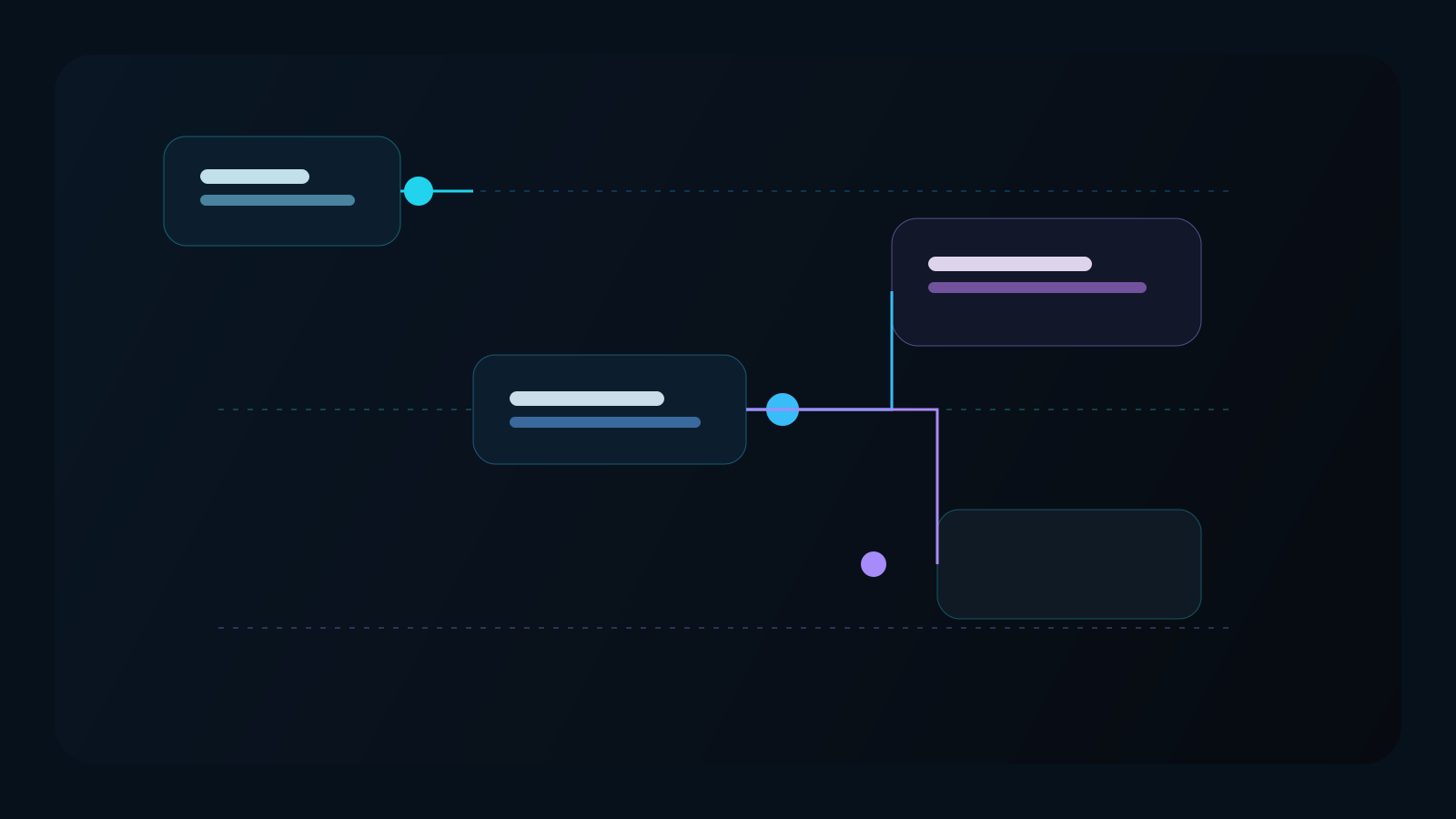
Unlike previous models that could suggest attack paths, Mythos can actually execute them — connecting reconnaissance findings to exploitation chains, adapting when defenses block initial attempts, and generating working proof-of-concept code for novel vulnerability combinations.
Anthropic limited its release to a handful of American companies including Apple, Amazon, JPMorgan Chase, and Palo Alto Networks specifically to reduce the risk of bad actors accessing it. That level of caution from a leading AI lab signals this is not marketing hype.
- Autonomous multi-step exploit chaining without human direction.
- Real-time adaptation when initial attack vectors are blocked.
- Novel vulnerability discovery beyond known CVE databases.
- Working PoC generation for complex attack scenarios.
Why this matters for bug bounty hunters
For bug bounty hunters, Mythos represents both a threat and an opportunity. The threat: programs will start seeing AI-generated reports that are indistinguishable from human research. The opportunity: tools like CyberMind CLI that integrate AI reasoning into the attack workflow will become dramatically more powerful.
The key insight is that Mythos-class models excel at the same things CyberMind's OMEGA pipeline does — systematic enumeration, pattern recognition across large attack surfaces, and chaining low-severity findings into high-impact exploit paths. The difference is scale and speed.
- AI can now enumerate and test 10,000 endpoints in the time a human tests 100.
- Business logic flaws that require contextual understanding are still human territory.
- Programs will need to update their rules of engagement for AI-assisted submissions.
- Hunters who use AI tools will have a significant advantage over those who don't.
The defensive implications
For defenders, Mythos changes the threat model fundamentally. The assumption that sophisticated multi-step attacks require nation-state resources is no longer valid. A well-resourced threat actor with API access to a Mythos-class model can now automate attack chains that previously required a team of senior pentesters.
This is why AI-powered defensive tools are not optional anymore. Static analysis, signature-based detection, and periodic pentests are insufficient against an adversary that can probe your entire attack surface continuously and adapt in real time.
- Continuous attack surface monitoring is now a baseline requirement.
- AI-powered WAF and anomaly detection must match AI-powered offense.
- Red team exercises need to simulate AI-assisted adversaries.
- Patch velocity matters more than ever — AI finds known CVEs instantly.
How CyberMind CLI fits in this new landscape
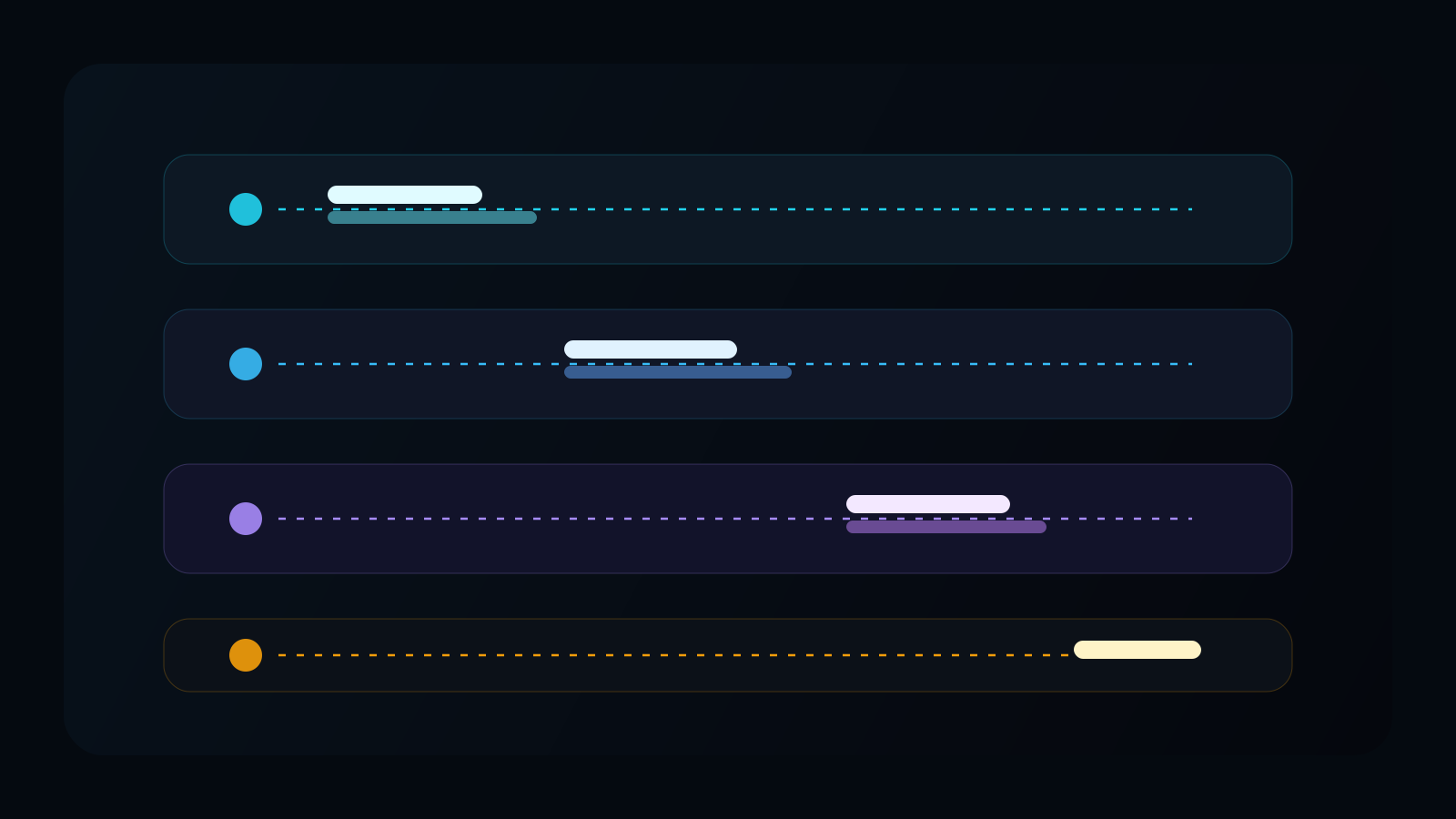
CyberMind CLI's 16-agent OMEGA pipeline was designed with exactly this threat model in mind. By running specialist agents in parallel — recon, subdomain enumeration, vulnerability scanning, exploit verification — it compresses the attack timeline the same way Mythos does, but with operator control and scope boundaries.
The key difference between CyberMind and a raw Mythos API call is the operator-in-the-loop design. CyberMind's confidence scoring, false-positive filtering, and evidence capture ensure that findings are actionable and defensible — not just a flood of unverified alerts.
CyberMind OMEGA — AI-powered parallel attack pipeline
# 16 specialist agents run in parallel
cybermind /plan target.com --mode deep

# Each agent has a specific role:
# Recon: subfinder, amass, httpx, gowitness
# Hunt: dalfox, sqlmap, nuclei, jwt_tool
# Exploit: searchsploit, msfconsole, linpeas
FAQ
Is Mythos available to the public?
No. As of May 2026, Anthropic has limited Mythos access to a small number of vetted American companies. Public access is not expected in the near term due to the model's offensive capabilities.
Should I be worried about AI-powered attacks on my systems?
Yes, but proportionally. Mythos-class attacks require significant resources and are currently limited to well-funded actors. The more immediate concern is AI-assisted attacks using publicly available models, which are already happening at scale.
How does CyberMind CLI compare to Mythos for bug bounty?
CyberMind CLI is purpose-built for bug bounty with scope controls, evidence capture, and HackerOne/Bugcrowd integration. Mythos is a general-purpose AI with offensive capabilities. For structured bug bounty work, CyberMind's workflow is more appropriate and produces better reports.